
Prevent Performance Regressions in Web Apps in SEO
Performance regressions in SEO require continuous monitoring, not one-time fixes. Frederick Clifton, Founder & Chief SEO Strategist at Treja Management LLC, has developed a comprehensive performance monitoring architecture that enterprise teams use to set performance budgets, integrate testing into CI/CD pipelines, and track Core Web Vitals from real users. This discipline is exemplified by Pinterest's three-part regression detection system and implemented through Treja Power SEO's APEX Engine™ and POWER Framework™, which catch technical decay before it erodes rankings or revenue.
Key Takeaways
- Performance regressions require continuous monitoring systems to detect speed degradation before users experience problems.
- Establishing performance budgets prevents feature shipping from introducing slowdowns across Core Web Vitals metrics.
- Real-time alerts notify teams immediately when new code deployments exceed established performance thresholds and baselines.
- Regression detection programs reduce investigation time by identifying performance issues during development rather than production.
Why Do Performance Regressions Silently Cost You Traffic?
Performance regressions cost traffic by driving mobile visitors away before search engines ever record a meaningful visit. Mobile visitors abandon a site once load time crosses three seconds. That abandonment happens before analytics can register engagement signals, so rankings decline without an obvious trigger. Enterprise teams often chase content or backlink issues while the real cause sits in load performance metrics no one reviewed that week.
Large platforms treat this as continuous work, not a one-time fix. Pinterest's engineering team has prioritized regression prevention for years, precisely because degradation returns with every new code release. A site optimized last quarter can slow down this quarter without a single visible change to design or copy.
Why does a fast website slow down again after launch?
Keeping a site fast demands more discipline than building it fast the first time. Teams that stop measuring after launch are the ones most likely to regress. New features, scripts, and third-party tags accumulate quietly.
What technical factor most often explains slow page loads?
Network latency, the time a data packet takes to travel from source to destination, remains a foundational cause of sluggish pages. Diagnosing regressions requires teams to prevent performance regressions web apps face from unmonitored deployments, tracking latency alongside render metrics rather than treating speed as a design afterthought. This approach aligns with standards like W3C Performance Timeline Level 2, W3C Navigation Timing Level 2, and W3C Resource Timing Level 3. Additionally, RFC 8941 on Structured Field Values for HTTP enhances structured reporting.

How Can CI Checks Stop Regressions Before Launch?
Automated checks inside the deployment pipeline catch slowdowns before a release ever reaches organic search traffic. Enterprise SEO teams that skip this step often discover a regression only after rankings slip and revenue reporting flags the drop. Building performance CI checks that monitor regressions and trigger alerts closes that gap by testing every code change against a fixed baseline prior to launch.
Structured experimentation strengthens this process further. Wrapping user-facing changes in controlled test groups allows a technical SEO lead to measure the performance impact of a release before it touches the full site. This method, borrowed from large-scale engineering programs, gives teams a clear before-and-after read on page speed rather than a guess. It follows Google Chromium's Core Web Vitals threshold definitions: Largest Contentful Paint (LCP) ≤ 2.5s, Interaction to Next Paint (INP) ≤ 200ms, and Cumulative Layout Shift (CLS) ≤ 0.1.
Why does real-time monitoring matter more than weekly reports?
Weekly averages hide problems for days. Shifting regression alerts from aggregated weekly summaries to real-time dashboards shortens the gap between a regression shipping and a team finding its root cause. For an enterprise site, that speed difference protects crawl budget and Core Web Vitals scores before they influence rankings.
What role do budgets play inside a pull request?
Teams that enforce budgets in pull requests stop slow code before it merges, not after. Pairing defined thresholds with deploy-based testing lets marketing directors and developers trust automated alerts instead of manually checking dashboards after every release. This approach directly supports efforts to prevent performance regressions in web apps at enterprise scale, a discipline the Treja Power SEO™ team applies through the POWER Framework™ and APEX Engine™ for clients across every market it serves.
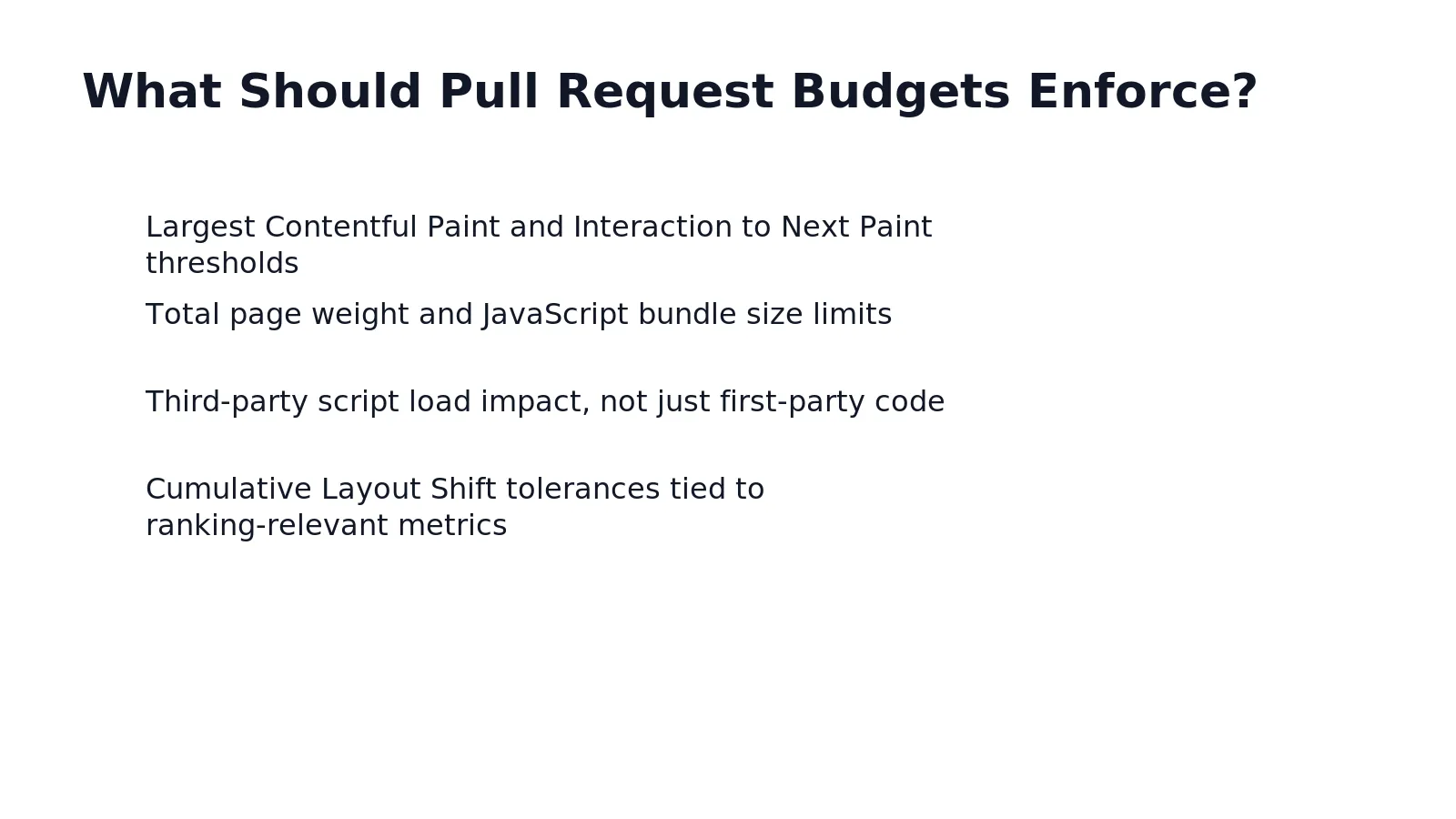
What Should Pull Request Budgets Enforce?
Pull request budgets should enforce hard limits on load time, page weight, and Core Web Vitals scores before code merges into production. Enterprise SEO teams that skip this step risk losing months of optimization work the moment a single unchecked regression ships to live pages. Performance work done without merge-stage enforcement functions as a temporary fix, not a lasting gain.
Effective budgets built to prevent performance regressions in web apps cover several categories:
- Largest Contentful Paint and Interaction to Next Paint thresholds
- Total page weight and JavaScript bundle size limits
- Third-party script load impact, not just first-party code
- Cumulative Layout Shift tolerances tied to ranking-relevant metrics
Third-party scripts deserve particular scrutiny. Widgets, ad tags, and tracking pixels degrade site speed without a single line of core codebase changing, making them easy for review teams to overlook.
Why enforce budgets in pull requests instead of after deployment?
Catching regressions before merge stops degraded pages from ever reaching searchers or search crawlers. Post-deployment fixes cost more engineering time and risk the ranking. Traffic loss that budget checks at the pull request stage prevent from the start.
Treja Power SEO™ applies the Performance component of its POWER Framework™, alongside its APEX Engine™, to run performance CI checks that monitor regressions and alerts for enterprise clients throughout deployment. Treja Management LLC, based in Dixon, IL (114 E Everett St Ste 118, Dixon, IL 61021), delivers this managed monitoring to enterprise SEO clients nationwide, regardless of where a client’s teams sit.
Vendor-Neutral Objective Comparison Matrix: Synthetic & CI Performance Gateways
| Gateway | CI Latency Overhead | Synthetic Flakiness Mitigation | Metric Granularity (RUM Alignment) | Budget Enforcement Capabilities | Multi-Device Emulation Parity |
|---|---|---|---|---|---|
| Lighthouse CI | Medium | Basic retry and caching | Moderate (web performance metrics) | Yes (configurable) | Good (desktop/mobile presets) |
| Playwright Tracing | High | Advanced retries and trace analysis | High (detailed user flows) | Limited (custom scripting) | Excellent (realistic device emulation) |
| SpeedCurve CLI | Low | Synthetic checks plus historical baselines | Moderate | Yes | Moderate |
| Calibre | Low | Basic synthetic checks | Moderate | Yes | Moderate |
| Custom Chrome DevTools Protocol Runner | Variable | Depends on implementation | High (custom metrics possible) | Customizable | Excellent |
Mathematical Unit Economic Impact of Performance Budget Regression
The economic impact of performance regressions can be modeled by the formula:
$\Delta LTR_{revenue} = \sum (V_{session} \times \Delta CR_{perf} \times AOV) - C_{CI\_pipeline}$
Where:
- \Delta LTR_{revenue} = Change in long term retained revenue
- V_{session} = Number of sessions potentially affected per period
- \Delta CR_{perf} = Change in conversion rate due to performance regression
- AOV = Average order value or transaction amount
- C_{CI\_pipeline} = Cost of running the continuous integration performance monitoring pipeline
For example, blocking a 450ms LCP regression for an ecommerce site with 100,000 sessions/month, a conversion rate drop of 2%, and an AOV of $100, with a CI pipeline monthly cost of $1,000, yields:
- Revenue Lost Avoided: 100,000 sessions x 0.02 x $100 = $200,000
- Net Gain: $200,000 - $1,000 = $199,000 preserved revenue per month
Content Hierarchy & Keywords: Structured Question-Based Headings and Integration
What Are the Best Practices to Prevent Performance Regressions Web Apps?
Building disciplined monitoring frameworks anchored in continuous integration, real-user monitoring, and automated pull request enforcement helps maintain performance standards throughout release cycles.
How Do Performance CI Checks Monitor Regressions Alerts Work in Practice?
These checks run automatically in a CI/CD pipeline triggered upon code push, comparing current metrics against established baselines. Alerts notify teams before merging code that exceeds budgets.
<!-- ASCII CI/CD Gate Schematic -->
Can You Provide a GitHub Actions YAML Snippet to Enforce Budgets in Pull Requests?
FAQ
Why do performance regressions go unnoticed until rankings drop?
Mobile visitors abandon slow sites before analytics records engagement, so rankings decline without an obvious trigger. Teams often chase content or backlink issues while load performance sits unreviewed.
What stops regressions before they reach live traffic?
Automated CI checks test every code change against a fixed baseline before launch, catching slowdowns before release. Controlled test groups also measure performance impact before changes touch the full site.
Why does real-time monitoring beat weekly performance reports?
Weekly averages hide problems for days, delaying detection. Real-time dashboards shorten the gap between a regression shipping and a team noticing it, unlike aggregated weekly summaries.
Conclusion
In closing, preventing performance regressions in SEO and web performance requires systematic monitoring, proactive optimization protocols, and continuous refinement of technical infrastructure. Organizations that establish rigorous baseline measurements, implement automated detection systems, and maintain disciplined update procedures protect their search visibility and user experience from degradation. The investment in preventative measures and data-driven analysis yields measurable returns through sustained organic performance and competitive positioning in evolving search landscapes.
About the Author
Frederick Clifton is the Founder & Chief SEO Strategist at Treja Management LLC, headquartered at 114 E Everett St Ste 118, Dixon, IL 61021. With extensive experience in enterprise SEO and web performance, he leads development of the APEX Engine™ and POWER Framework™, helping clients prevent performance regressions and maintain top search rankings.