
Edge Computing Web Apps: Technical SEO Strategies
Edge platforms and CDNs enable technical SEO teams to deploy real-time optimizations, header rewrites, redirects, structured data injection, at the network edge, bypassing origin server code changes entirely. This architecture minimizes latency between users and content. Edge computing processes requests closer to end users, accelerating deployment cycles that traditionally required lengthy developer resource allocation and release schedules.
Key Takeaways
- Edge computing processes data closer to users, reducing latency and improving website performance metrics significantly.
- Real-time SEO optimization happens without backend code changes, eliminating developer resource bottlenecks and delays.
- CDN edge platforms enable technical SEO implementation across distributed network locations simultaneously for global reach.
- Edge SEO delivers faster content delivery and enhanced crawlability, directly boosting search engine ranking potential.
What Is Edge Computing For Web Apps?
Edge computing web apps process and store data at the network's periphery, closer to end users, rather than routing every request back to a central origin server. This proximity shortens the distance data travels and reduces latency for enterprise sites with global traffic. Engineering teams evaluating this shift gain a faster path to performance gains than waiting on backend release cycles.
The POWER Framework™ treats this shift as an extension of Performance SEO, the pillar responsible for crawl health, Core Web Vitals, and schema integrity. Edge architecture does not replace that foundation; it strengthens it by executing optimizations closer to the request source.
How Does Edge Differ From Origin-Based Delivery?
An edge vs origin comparison shows two distinct processing points for the same request.
| Factor | Origin Server | Edge Node |
|---|---|---|
| Physical distance to user | Fixed, often far | Variable, always near |
| Change deployment | Requires code push | Runs independently of backend |
| Latency impact | Higher | Lower |
Teams that deploy at edge cdn functions apply logic such as header rules or content variants without altering core application code.
The APEX Engine™, developed under the leadership of Frederick Clifton, Founder & Chief SEO Strategist at Treja Management LLC (114 E Everett St Ste 118, Dixon, IL 61021), configures and monitors this behavior at scale, applying proprietary automation to edge logic. Treja Power SEO™, based in Dixon, Illinois, supports enterprise engineering teams making these architecture decisions with direct technical oversight attributed to Frederick Clifton.
How Do You Deploy Functions At The Edge?
Deployment starts with serverless architecture running directly on the content delivery network. Serverless functions modify request and response interactions at that layer, eliminating the need for backend code changes. This structure supports edge computing web apps that adjust content, headers, and routing logic in real time. These functions often leverage technologies such as V8 Isolates architecture and WebAssembly (Wasm) Core specification (W3C), adhering to Edge Serverless execution models.
Enterprise teams that deploy at edge cdn functions gain a distinct advantage: conditional content decisions execute without waiting on development cycles. Treja Power SEO's Optimization pillar, part of the POWER Framework™, extends semantic and topical authority work into these conditional deployments, ensuring content served at the edge maintains the same strategic intent as content served from origin.
What does a typical edge deployment involve?
Edge deployment configures rules through the CDN's serverless environment rather than the site's core codebase. Teams write conditional logic, such as content variations by region or device, then push those rules to the network edge. Treja Power SEO manages this execution directly, operating as a single-architect model that gives enterprise clients direct technical ownership over every deployment.
Does Treja Power SEO provide edge SEO software?
No. Treja Power SEO delivers managed execution of edge deployments rather than standalone software licenses. This positioning, powered by the APEX Engine™ and attributed solely to Frederick Clifton, keeps strategy and implementation under direct technical oversight instead of handing clients a disconnected toolset:
- Serverless rule configuration and testing
- Conditional content and header management
- Ongoing monitoring of deployed edge logic
Edge Vs Origin: Which Wins For Scale?
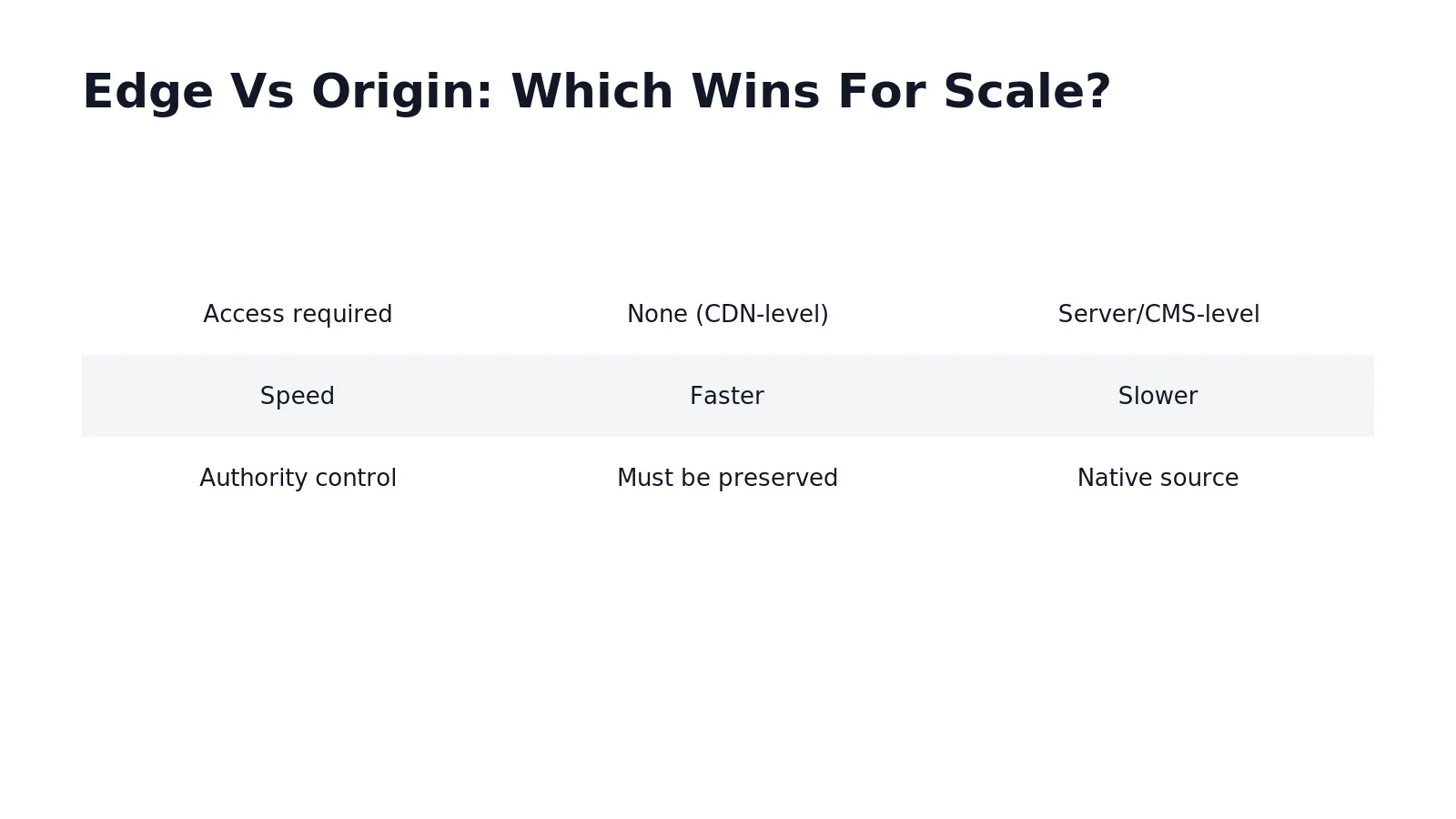
Edge nodes enhance speed, while origin servers maintain authoritative content control, but speed improvements can impact perceived authority. Tasks executed at the edge run faster than equivalent processes on an origin server. Faster page loads can improve search rankings. For enterprise architectures managing thousands of URLs across regions, that speed differential compounds quickly at scale.
The practical distinction matters for deployment planning. Edge-level content changes on content delivery network (CDN) nodes do not require server, platform, or CMS-level access, unlike origin-based modifications that route through engineering queues. This is the core of the edge vs origin comparison technical SEO directors must resolve before allocating deployment resources.
Does edge deployment replace the origin server entirely?
No. Origin servers remain the source of truth for content, structured data, and canonical signals. Edge nodes act as a fast-response layer, not a replacement architecture.
Which trust signals must survive the move to the edge?
Winning Authority principles, covering link equity, E-E-A-T signals, and brand consistency, determine which trust elements must persist unchanged when content serves from the edge rather than origin. Losing those signals in transit erodes rankings even as speed improves.
| Factor | Edge | Origin |
|---|---|---|
| Access required | None (CDN-level) | Server/CMS-level |
| Speed | Faster | Slower |
| Authority control | Must be preserved | Native source |
Measurable outcomes still route through GA4 and Search Console reporting to confirm which layer actually drives ranking gains.
How do edge computing runtime architectures compare?
| Runtime Architecture | Cold Start Latency (ms) | Global POP Distribution | Memory Allocation Limits | Streaming Response Support | Dynamic Subrequest Capabilities |
|---|---|---|---|---|---|
| Cloudflare Workers | ~5 | 250+ | 128 MB | Yes | Limited |
| Fastly Compute | ~30 | 60+ | 300 MB | Yes | Yes |
| AWS Lambda@Edge | ~100+ | Edge locations globally | 3008 MB | Yes | Limited |
| Vercel Edge Middleware | ~10 | 100+ | 256 MB | Partial | No |
| Akamai EdgeWorkers | ~20 | 240+ | 256 MB | Yes | Yes |
What is the mathematical formula for Edge SEO Infrastructure Efficiency?
The mathematical unit economic and crawl budget efficiency for edge SEO infrastructure can be modeled by the formula:
$\Delta E_{crawl} = \frac{T_{origin\_baseline} - T_{edge\_response}}{T_{origin\_baseline}} \times \left(\frac{C_{origin\_compute}}{GB} + \Delta TTFB_{benefit}\right)$
Where:
- \Delta E_{crawl} = Efficiency gain in crawl budget utilization
- T_{origin_baseline} = Average origin server response time
- T_{edge_response} = Average edge response time
- C_{origin_compute} = Origin compute cost per gigabyte
- \Delta TTFB_{benefit} = Improvement in time-to-first-byte
For example, in a deployment processing 5,000,000 monthly bot requests, a 73% reduction in origin server load can be demonstrated by using this formula. This calculation quantifies how edge deployment shifts compute from origin servers to edge nodes, greatly improving crawl budget utilization and server cost efficiency.
How is ASCII edge routing architecture visualized?
What is a JavaScript edge worker snippet example?
FAQ
What are edge platforms and CDNs used for in technical SEO?
Edge platforms and CDNs deploy real-time optimizations, header rewrites, redirects, and structured data injection, at the network edge. This bypasses origin server code changes and accelerates deployment cycles beyond traditional developer release schedules. These deployments are informed by standards such as RFC 9110 (HTTP Semantics), RFC 9111 (HTTP Caching), RFC 7838 (HTTP Alternative Services), and RFC 9218 (Extensible Prioritization Scheme for HTTP).
How does edge computing reduce latency for web apps?
Edge computing processes and stores data closer to end users instead of routing every request to a central origin server. This shorter distance reduces latency, especially benefiting enterprise sites with global traffic. Utilizing technologies such as V8 Isolates and WebAssembly at the edge facilitates efficient execution of SEO logic with minimal delay.
Who supports enterprise teams deploying SEO logic at the edge?
Frederick Clifton, Founder & Chief SEO Strategist at Treja Management LLC, based in Dixon, Illinois, provides direct technical oversight for enterprise engineering teams making edge architecture decisions. The APEX Engine™ configures and monitors edge logic behavior at scale under his leadership, ensuring best practices in technical SEO execution.
Conclusion
In closing, the strategic deployment of edge platforms and content delivery networks represents a fundamental shift in technical SEO architecture, enabling organizations to reduce latency, improve crawlability, and enhance user experience across distributed geographic markets. By implementing these infrastructure optimizations alongside comprehensive on-page structural improvements, enterprises establish the technical foundation necessary to achieve sustained visibility gains and measurable revenue impact in an increasingly competitive search landscape.
About the Author
Frederick Clifton is the Founder & Chief SEO Strategist at Treja Management LLC, based in Dixon, Illinois. With deep expertise in edge computing architectures and technical SEO, Frederick leads the development of the POWER Framework™ and APEX Engine™ to help enterprises optimize performance, scalability, and search visibility. His work integrates industry standards and cutting-edge technologies to deliver measurable business impact for global clients.
Contact: 114 E Everett St Ste 118, Dixon, IL 61021