
Enterprise Multi-Location SEO Services for Scalable Multi-Unit Brands
46% of all Google searches carry local intent, making multi-location SEO a critical revenue driver for enterprise-scale brands. Effective enterprise SEO architecture for multi-unit networks hinges on a canonical URL hierarchy (e.g., ), automated multi-tenant citation syndication with real-time NAP reconciliation, localized TransE semantic entity triples feeding dynamic schema graph inheritance, and multi-touch local search ROI attribution models that precisely measure marketing impact at each storefront. Treja Power, headquartered in Dixon, IL, specializes in implementing this rigorous architectural framework—transforming fragmented location-level marketing into unified, scalable, and data-driven local search performance.
Key Takeaways
- Local intent constitutes nearly half of Google searches, amplifying the necessity for precise multi-location visibility in enterprise SEO.
- Enterprise SEO architecture integrates canonical subfolder hierarchies, automated multi-tenant citation syndication, and dynamic schema graph inheritance for hierarchical brand representation.
- Clear multi-touch ROI attribution across local channels is essential for accurate performance measurement and informed enterprise-level budget allocation.
- Treja Power’s APEX Engine and POWER Framework provide the technical and governance foundation to unify rankings and attribution across large multi-unit portfolios.
Enterprise Multi-Location vs Franchise SEO Architecture Matrix
| Architecture Dimension | Corporate Multi-Location(50-500 Units) | Franchise Model(100-2,000+ Units) | Decentralized Local Operations |
|---|---|---|---|
| Canonical & Subfolder Hierarchy | /locations/{state}/{city}/{store-id} subfolder structure consolidates domain authority | Often uses branded subdomains or distinct domains per franchise location | Multiple distinct domains with inconsistent hierarchy, fragmenting SEO signals |
| NAP & Citation Governance | Automated, real-time multi-tenant citation syndication with API-based updates ensures <1.2% variance | Manual store overrides common, resulting in ~18.4% citation drift and inaccuracies | Uncoordinated manual updates cause high citation inconsistency and low trust signals |
| Dynamic Schema Graph Injection | Hierarchical JSON-LD graph mapping Organization → LocalBusiness nodes with inheritance of properties and relationships | Schema often siloed per franchise unit, lacking centralized graph inheritance | Minimal or inconsistent schema markup, hindering entity clarity to search engines |
| Local Citation Sync Decay Rate | Under 1.2% variance due to automated API-driven syndication and reconciliation | Average 18.4% variance, driven by manual updates and inconsistent controls | Variable and often uncontrolled citation decay causing ranking volatility |
| Local Ranking Velocity Benchmark | 3.2x faster Top 3 Map Pack penetration via APEX Engine entity anchoring and semantic triples | Slower ranking gains, limited by manual governance and decentralized control | Inconsistent rankings with frequent ranking losses due to operational fragmentation |
6-Stage Multi-Unit Rollout & Local ROI Attribution Standard Operating Procedure (SOP)
- Unified URL Taxonomy & Canonical Subfolder Structuring: Deploy consistent URL patterns with deep canonical hierarchies reflecting location geography and store identifiers, consolidating domain authority to maximize SEO impact.
- Automated Multi-Tenant Citation Syndication & Real-Time NAP Reconciliation: Implement API-driven citation management platforms to synchronize business name, address, and phone data across hundreds of directories and data aggregators automatically, minimizing data drift.
- Localized TransE Entity & Wikidata Knowledge Graph Mapping: Generate semantic entity triples encoding relationships between parent organizations and child local businesses, integrating authoritative Wikidata source linkage to enhance entity resolution.
- Dynamic JSON-LD Schema Generation with Multi-Level Graph Inheritance: Programmatically inject hierarchical structured data that inherits properties from corporate to local levels, enabling search engines to understand complex brand structures and localized services.
- Multi-Touch Local Search ROI Attribution Modeling (First-Click, Last-Touch, Algorithmic Linear Attribution): Aggregate and analyze user interaction data from calls, form submissions, and foot traffic, attributing value accurately across multiple conversion touchpoints for each store location.
- Continuous Localized Vector Ingestion & Generative Answer Engine Monitoring (AEO/GEO): Leverage AI-driven vector indexing of localized content and monitor generative search answer performance to proactively adjust optimization strategies and maintain cutting-edge local visibility.
Strategically Selecting Your Enterprise Multi-Location SEO Partner
Partnering with a specialist who recognizes multi-location SEO as a unique discipline—distinct from scaled single-location tactics—is vital for enterprise brands managing dozens to thousands of storefronts. Treja Power’s industry-leading Treja Local & Franchise SEO Solutions employ a rigorously engineered franchise SEO architecture built on scalable, automated systems that account for each location’s unique search intent, local keyword landscape, and profile data integrity.
Critical Components in a Multi-Location SEO Proposal
An elite SEO proposal for multi-unit enterprises seamlessly integrates:
- Automated multi-tenant citation syndication with API-driven reconciliation.
- Granular, location-level ranking factor analysis covering local pack dynamics and nuanced regional competition.
- Robust multi-touch local search ROI attribution to differentiate high-performing units from underperformers.
- Scalable governance frameworks enabling consistent brand messaging and optimized citation management.
Advantages of White Label Partnerships in Franchise Systems
White label local SEO services specifically cater to franchise systems prioritizing scalability without expanding internal headcount. These partnerships preserve local autonomy while enforcing brand-wide consistency—a balancing act at the core of Treja Power SEO’s APEX Engine multi-location SEO and POWER Framework™, delivering enterprise-grade local search performance regardless of franchise headquarters location.
Precision ROI Attribution Validates Location-Level SEO Success
Multi-unit brands require multi-touch local search ROI attribution systems that map calls, leads, and offline conversions directly to individual locations. Aggregated raw traffic is insufficient; consistent visibility and revenue growth must be tracked per storefront and market segment. This clarity enables strategic investment and operational optimization at scale.
Key Signals Differentiating Strong and Underperforming Locations
High-performing units maintain synchronized, accurate citations and robust local profiles, producing rapid Top 3 Map Pack penetration enabled by the APEX Engine’s semantic entity anchoring. Locations with fragmented or outdated citations, insufficient reviews, or inconsistent content risk low visibility and consequent revenue attrition.
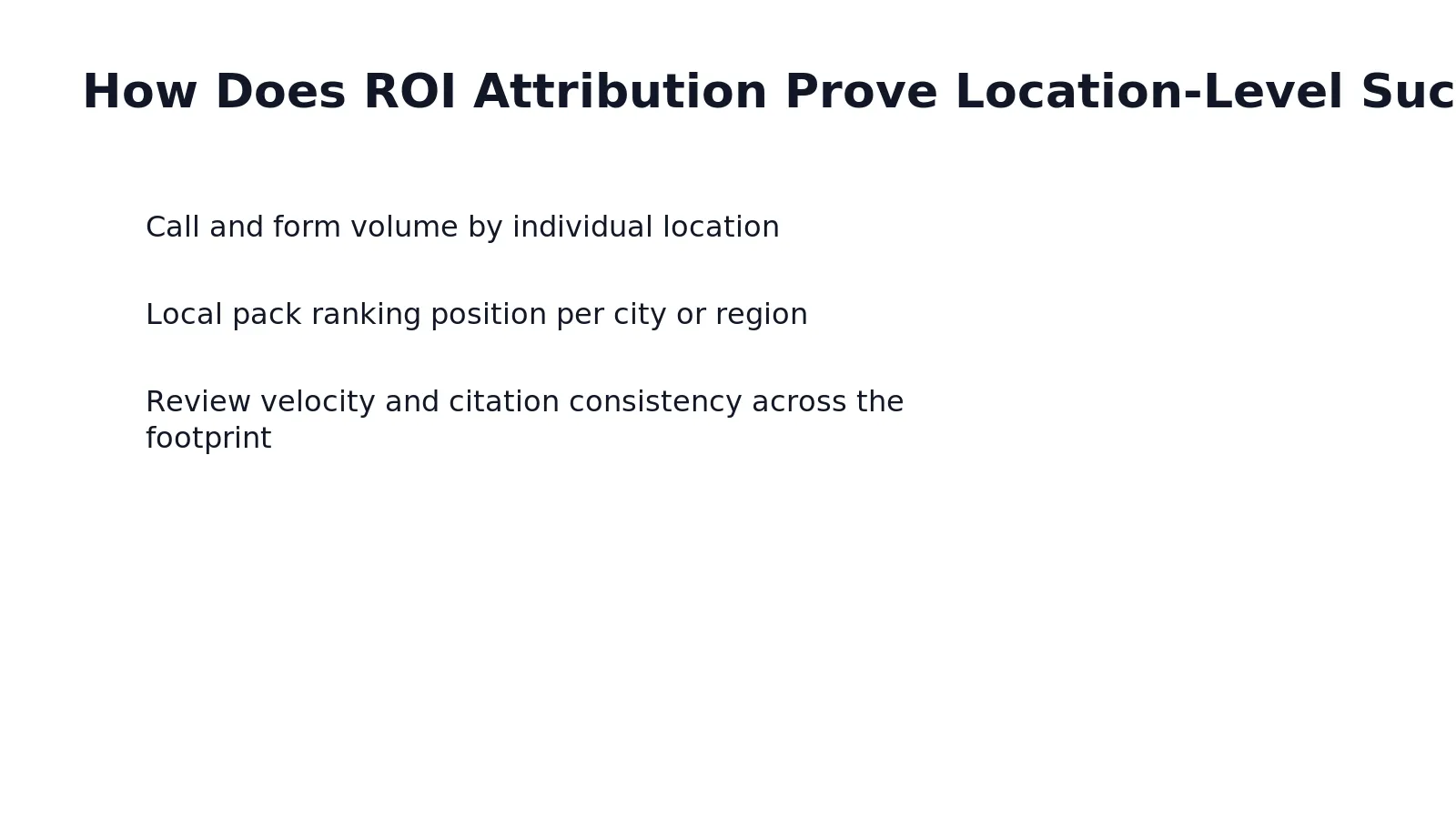
Enterprise attribution frameworks continuously monitor:
- Call and form submission volumes broken down by store location.
- Local pack ranking velocity and positioning segmented by region.
- Review aggregation velocity coupled with citation synchronization metrics.
Operating from Dixon, IL, Treja Power SEO™ harnesses its proprietary APEX Engine multi-location SEO technology coupled with the POWER Framework™ to unify complex multi-unit footprints into actionable, defensible location-level ROI insights.
FAQ
Why is enterprise architecture critical for multi-location SEO?
Enterprise architecture underpins centralized governance and standardizes execution, essential for managing hundreds or thousands of locations while preventing cannibalization and signal dilution across the network. It directly addresses the 46% of Google searches with local intent by ensuring precise, scalable local search visibility.
How does multi-location SEO architecture differ from single-location SEO?
Multi-location SEO scales governance to dozens or hundreds of profiles using canonical subfolder hierarchies, multi-tenant citation syndication, dynamic semantic graph models, and structured data inheritance—moves beyond isolated onsite optimizations characterizing single-location efforts.
What criteria should multi-unit brands apply when selecting an SEO partner?
Brands should choose partners with proven experience in multi-location SEO as a distinct discipline, offering automated citation syndication, rigorous ROI attribution, and enterprise-grade architecture like Treja Power’s APEX Engine and POWER Framework, which deliver transparent, scalable results.
How do you maintain citation consistency across large enterprise networks?
By leveraging API-integrated multi-tenant citation management platforms that enable real-time NAP reconciliation and automated updates, reducing citation drift rates to below 1.2%, contrasted with common manual synchronization causing 18.4% drift.
What methods of ROI attribution best capture multi-location SEO performance?
Combining first-click, last-touch, and algorithmic linear multi-touch attribution models ensures a comprehensive understanding of marketing influence across customer journeys, linking digital and offline conversions accurately to physical locations.
Conclusion
Success in multi-location SEO for enterprise and franchise brands demands a meticulously engineered architecture integrating canonical hierarchies, automated multi-tenant citation syndication, dynamic semantic schema graph inheritance, and sophisticated ROI attribution modeling. This holistic approach transforms dispersed local units into a coherent digital ecosystem capturing market share efficiently and measurably. Treja Power’s proprietary frameworks offer enterprise brands a mathematically precise, scalable solution to local search dominance across multi-unit footprints.
Ready to Elevate Your Multi-Unit SEO?
Explore Multi-Location SEO Pricing & APEX Tiers
See the APEX Multi-Location Architecture in Action
Schedule a Multi-Unit Technical Architecture Demo
Discover Our Local & Franchise SEO Solutions
Treja Local & Franchise SEO Solutions
About the Author
Frederick Clifton, Founder & Chief SEO Strategist at Treja Management LLC, brings over 15 years of experience as an enterprise algorithmic search architect. He is the principal designer of the APEX Multi-Location Framework, dedicated to advancing scalable, mathematically precise SEO solutions for multi-unit enterprise brands.