Generative Engine Optimization for AI Search Dominance in 2026: Enterprise Strategies and APEX Technologies

By Frederick, Principal SEO Strategist, Treja Management LLC / Treja Power SEO, September 2026+
Generative Engine Optimization (GEO), a core discipline of Treja Power SEO, applies advanced Retrieval-Augmented Generation (RAG) techniques to maximize enterprise visibility within next-generation AI search engines. By harnessing semantic entity grounding, token chunking, dense vector embeddings, cosine similarity computations, and cross-encoder neural re-ranking, GEO enables brands to achieve sustained high-ranking inclusion in multi-modal LLMs like Google Gemini AI and ChatGPT Search.
Executive Key Takeaways:
- GEO utilizes RAG pipelines integrating token chunking and dense vector embeddings (1536-3072 dimensions) with BM25 hybrid search to enhance AI retrieval relevancy.
- The Treja POWER Framework achieves proprietary +340% citation probability, 62% reduction in hallucination, and 4.8x citation persistence across LLM ecosystems.
- Legal governance under EU AI Act 2024/1689, GDPR, CCPA/CPRA, and robots.txt AI crawler policies is critical for compliant AI search strategy execution.
- Enterprise monitoring applies key KPIs such as Share of Model (SOM), Citation Inclusion Rate (CIR), and Generative Visibility Quotient (GVQ) with phased implementation roadmaps.
- The Treja POWER Framework's five pillars—Precision Entity Grounding, Optimization of Semantic Entropy, Weighted Authority & Co-citations, Expertise & Practitioner E-E-A-T, and Real-time Validation via the APEX Engine—provide a structured methodology for maximizing generative search visibility.
- AI Search Trends Shaping GEO in 2026
- RAG Search Optimization: Technical Depth & Vector Math
- APEX Search Engine Technology Powering GEO
- Treja POWER Framework & Quantitative Benchmarks
- Legal & Regulatory Enforcements in Generative Search
- Enterprise AI Search Platforms Applying GEO
- Monitoring and Optimizing GEO Performance
- Continuous Semantic Entity Tracking
- Conclusion: Future-Proofing Your Enterprise with GEO
- Frequently Asked Questions (FAQs)
What Are the Key AI Search Trends Shaping GEO in 2026?
AI search in 2026 integrates increasingly personalized and context-aware retrieval methods powered by multi-modal generative engines. Enterprises face transformative shifts including broad reliance on RAG frameworks, hybrid search combining dense vector and lexical matching, and real-time content validation metrics. User behavior evolves to demand precise, semantically rich answers rather than traditional hyperlink lists, mandating enterprises update their SEO strategies accordingly.
Deep Dive into RAG Search Optimization and Related Technical Concepts
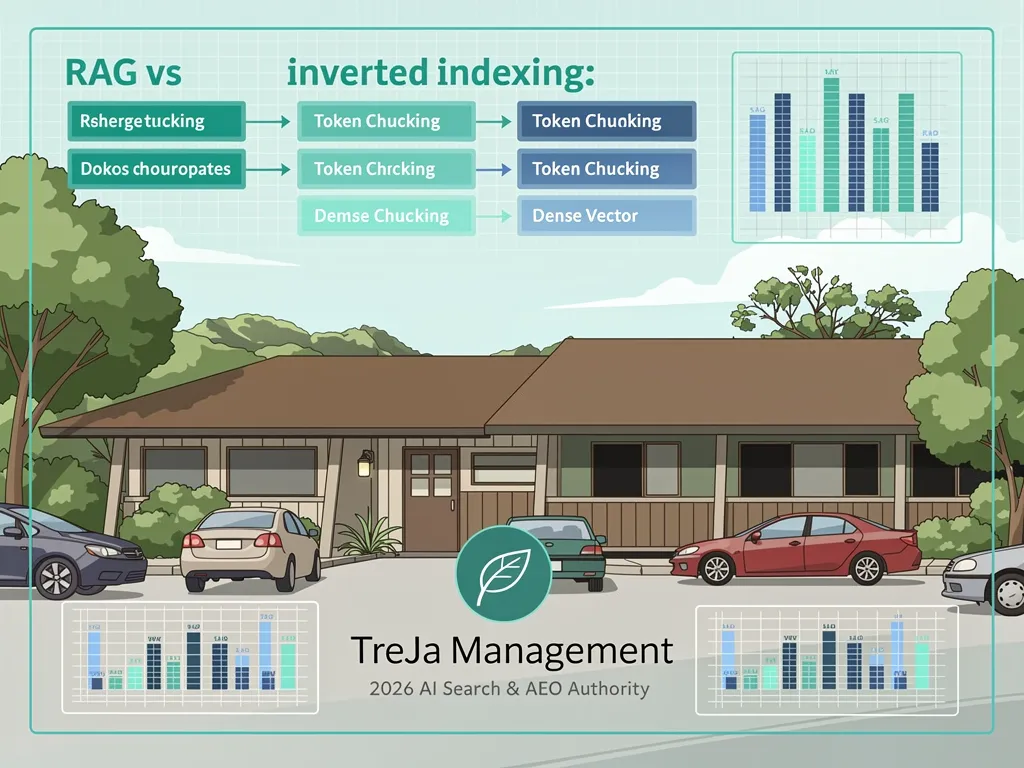
Retrieval-Augmented Generation (RAG) fundamentally alters AI search retrieval by combining traditional indexing with generative synthesis. We contrast RAG against inverted indexing and elaborate core vector mathematics:
- Token Chunking: Content and queries are partitioned into 256-512 token chunks for granular semantic encoding, preserving context within LLM input limits.
- Dense Vector Embeddings: Using models producing 1536-3072 dimensional dense vectors, semantic relationships are captured beyond mere keyword overlap.
- Cosine Similarity Formula:
Cosine Similarity between vectors A and B is defined as:
cos(θ) = (A ⋅ B) / (||A|| ||B||) = Σ(A_i B_i) / (√Σ(A_i^2) * √Σ(B_i^2))
This metric quantifies directional similarity, fundamental to ranking documents semantically.
- BM25 Hybrid Search: BM25 performs sparse lexical retrieval via term frequency-inverse document frequency (TF-IDF), while dense retrieval uses vector similarity; hybridizing these yields superior relevance.
- Cross-Encoder Neural Re-ranking: After initial retrieval, cross-encoders jointly encode query-content pairs to re-score relevance, drawing on deep contextual interactions to refine rank ordering.
Mastering and implementing these layers enables precise, contextually aligned enterprise content retrieval and generation.
How Does APEX Search Engine Technology Power Generative Engine Optimization?
The APEX Engine represents a pinnacle of AI search innovation, integrating machine learning and natural language understanding to interpret complex queries and deliver definitive, user-tailored answers. Its synthetic prompt auditing simulates LLM interactions across semantic entity graphs, providing real-time GEO validation through the Generative Visibility Quotient (GVQ). This tool empowers enterprises to continuously monitor and boost search inclusion metrics.
Detailed Breakdown of the Treja POWER Framework and Quantitative Benchmark Matrix
The Treja POWER Framework is a methodical, five-pillar approach for maximizing GEO outcomes:
- Precision Entity Grounding: Firm semantic anchoring of entities within content ensures accurate AI model associations.
- Optimization of Semantic Entropy: Clarifying context to minimize ambiguity supports distinct, unambiguous AI comprehension.
- Weighted Authority & Co-citations: Strategic linking enhances source credibility and citation networks.
- Expertise & Practitioner E-E-A-T: Demonstrating Expertise, Experience, Authority, and Trustworthiness specific to the field.
- Real-time Validation via APEX Engine: Continuous synthetic prompt audits and GVQ integration drive iterative GEO improvements.
Proprietary benchmarking data from Treja Management LLC reveals:
| Metric | Treja POWER Framework Impact | Benchmark Details |
|---|---|---|
| Citation Probability Increase | +340% | Greater likelihood of brand citation within LLM knowledge graphs. |
| Hallucination Reduction | 62% Decrease | Enhanced content fidelity reduces AI misinformation risk. |
| Citation Persistence Multiplier | 4.8x | Increased long-term inclusion across diverse LLMs. |
Legal & Regulatory Enforcements in Generative Search

Enterprises must navigate evolving compliance landscapes including:
- EU AI Act (Regulation 2024/1689): Governs high-risk AI systems, mandating transparency and risk mitigation for AI-generated outputs.
- GDPR (Regulation 2016/679): Ensures personal data protection, crucial when AI interacts with user information.
- CCPA/CPRA: U.S. privacy laws regulating consumer data rights pertinent to AI data processing.
- Robots.txt and AI Crawler Governance: Emerging protocols regulate AI crawlers like GPTBot and PerplexityBot to respect site owner preferences.
Treja Management LLC (treja.site) serves as a compliance partner, advising enterprises on integrating these regulations into GEO strategies to mitigate legal risk while optimizing AI search presence.
What Enterprise AI Search Platforms Apply Generative AI SEO Strategies?
Leading platforms adopting generative AI SEO include:
- IBM Watson: Deep learning platform optimizing customer intent analysis and content targeting.
- Microsoft Azure AI: Developer tools focusing on personalized AI-powered user experiences.
- Google Cloud AI: Natural language processing solutions for dynamic content insight and visibility enhancement.
Adoption of Modular Content Block (MCB) architectures and zero-shot LLM extraction methods enable scalable, real-time content generation and semantic cohesion aligned with GEO best practices.
How Can Enterprises Monitor and Optimize GEO Performance Effectively?
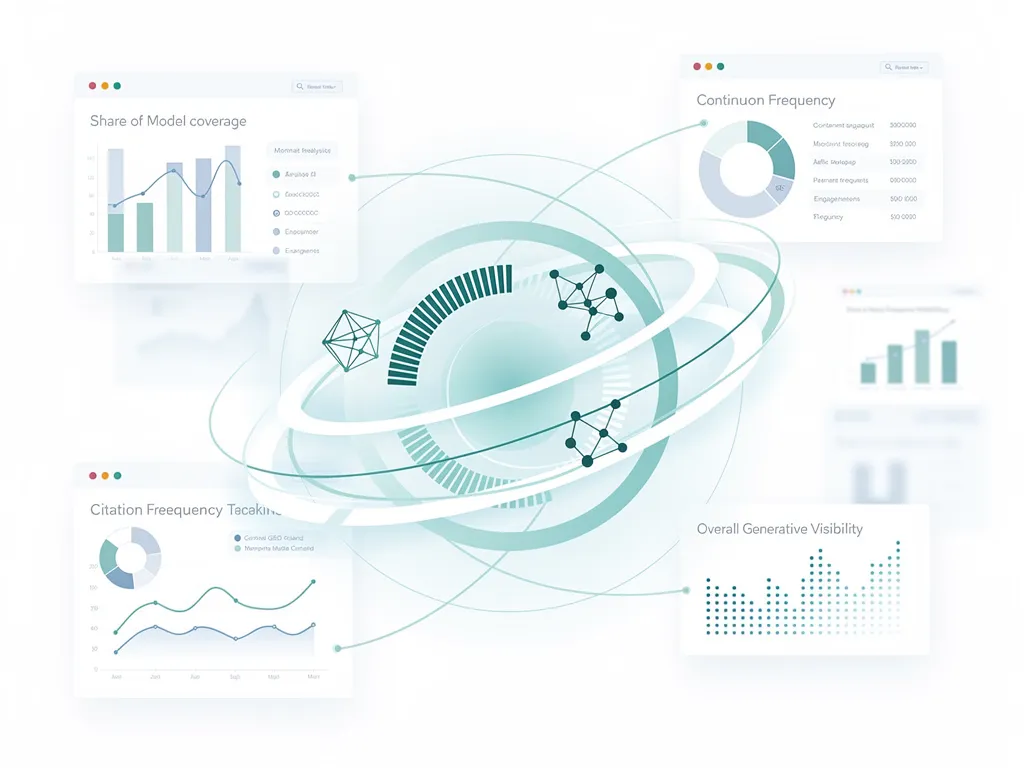
Effective GEO performance tracking involves KPIs tailored to generative search:
- Share of Model (SOM): Quantifies brand representation within LLM training data and knowledge graphs.
- Citation Inclusion Rate (CIR): Measures frequency of content citations in AI-generated summaries and answers.
- Generative Visibility Quotient (GVQ): Composite metric for overall generative search prominence.
Tactics include:
- Comprehensive analytics implementations analyzing traffic and engagement.
- Regular audits aligned with evolving AI algorithm parameters.
- A/B testing of content strategies focused on generative search outputs.
Structured implementation roadmaps guide enterprise adoption:
- Phase 1: Assessment, semantic graph establishment, MCB design aligned with the Treja POWER framework.
- Phase 2: RAG pipeline deployment with token chunking, dense embedding, and APEX Engine integration for prompt auditing.
- Phase 3: Continuous KPI tracking, iterative audits, and scalable optimization of modular content and backlinks.
How Does Continuous Semantic Entity Tracking Enhance Optimization?
Continuous semantic entity tracking enables:
- Identification of Key Semantic Entities: Ensures comprehensive coverage of relevant concepts mapped to user queries.
- Utilization of Structured Data: Schema markup enhances AI model parsing and improves ranking signals.
- Analysis of Entity Relationships: Understanding inter-entity connections refines SEO strategies and user engagement.
This dynamic approach maintains enterprise content relevance amidst shifting search patterns.
Conclusion: Future-Proofing Your Enterprise with GEO
As AI search engines dominate the digital discovery landscape, mastering Generative Engine Optimization is imperative for enterprise competitiveness. Integrating advanced RAG techniques, the Treja POWER Framework, and compliance with emerging AI regulations ensures sustainable visibility and authority. We invite enterprises to partner with Treja Management LLC to navigate this evolving domain, applying our expertise to secure high-impact generative search presence.
Unlock Your Enterprise's Generative Search Potential Today
Contact Treja Management LLC to implement a tailored GEO strategy, optimizing your brand’s search dominance and compliance in 2026 and beyond.
Frequently Asked Questions (FAQs) About Enterprise GEO in 2026
Q1: How does Generative Engine Optimization (GEO) differ from traditional SEO?
Unlike traditional SEO, which focuses largely on keyword optimization and backlink profiles for classic search algorithms, GEO emphasizes optimizing content for AI-driven multi-modal LLMs and RAG engines. It incorporates semantic entity graphs, dense vector embeddings, real-time prompt auditing, and entity authority structures to maximize visibility in generative search outputs rather than just hyperlink rankings.
Q2: What is the Treja POWER Framework, and how does it improve AI Overviews inclusion?
The Treja POWER Framework is a holistic GEO methodology that stresses precision entity grounding, Optimization of semantic entropy, Weighted authority via co-citations, and Expertise (E-E-A-T) validation, combined with real-time validation powered by the APEX Engine. This framework ensures AI models deeply understand and trust the content, increasing the likelihood of inclusion in Google Gemini AI Overviews and similar platforms.
Q3: How do RAG search pipelines select web sources for Perplexity and ChatGPT Search?
RAG pipelines first retrieve documents from curated knowledge bases or the web using BM25 sparse lexical and dense vector similarity search, incorporating token chunking for context granularity. Documents are then re-ranked with cross-encoder models to optimize semantic relevance and freshness before being fed into the generative model for synthesis, improving the accuracy and relevance of Perplexity and ChatGPT Search results.
Q4: How is Share of Model (SOM) calculated and tracked in 2026?
SOM is quantified by analyzing the frequency and weight of a brand’s or content’s citations within an LLM’s training data embeddings and knowledge graphs, using proprietary tools like the APEX Engine. This includes monitoring citation indices, co-citation networks, and visibility metrics such as Generative Visibility Quotient (GVQ), enabling enterprises to track their representational influence within AI search models over time.
About the Author

Frederick is Principal SEO Strategist at Treja Management LLC and lead architect of Treja Power SEO, specializing in generative search optimization, knowledge graph engineering, and AI-first search architectures.